Asset datasheet
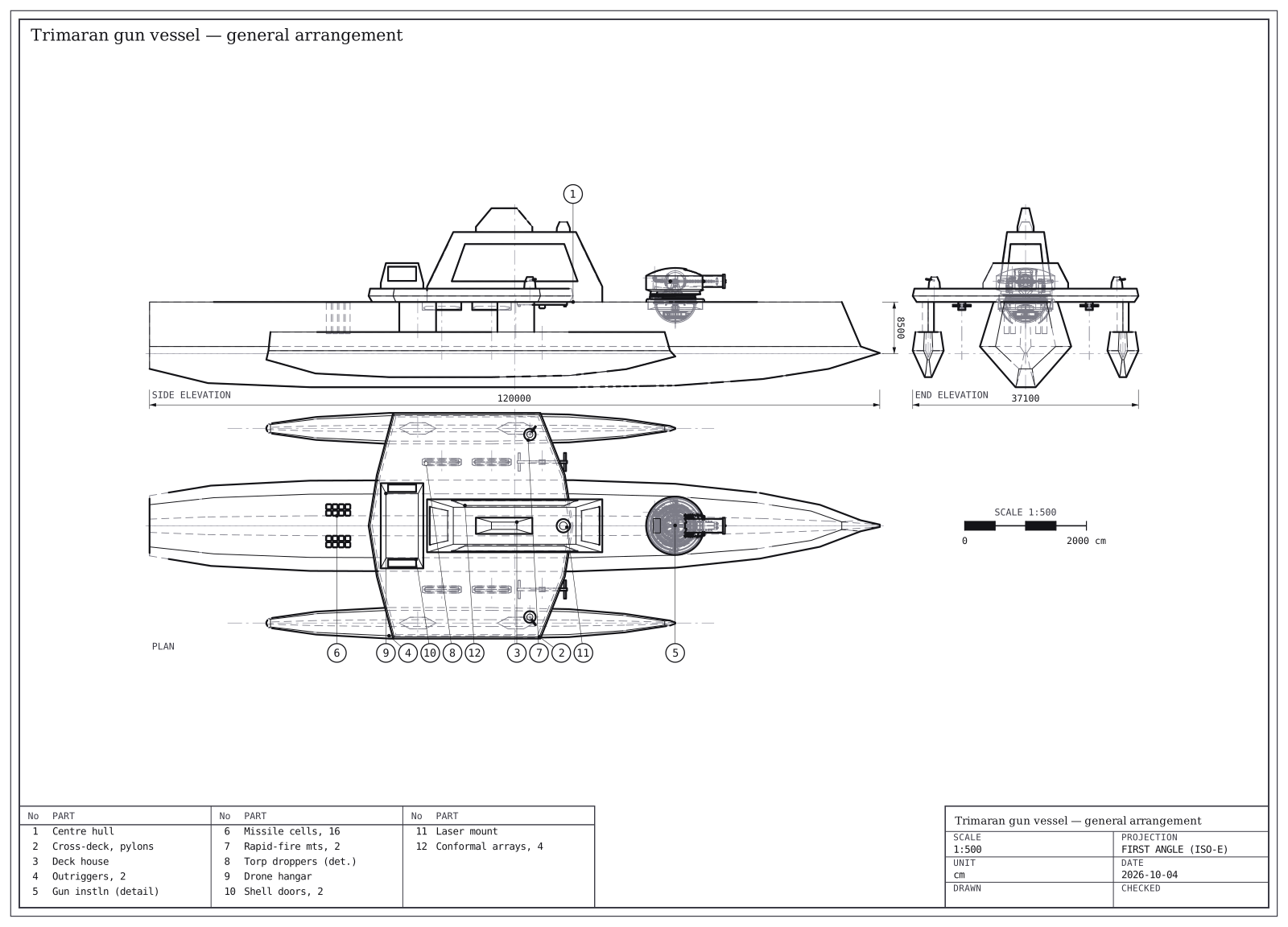
Low-observable trimaran — general arrangement
A low-observable trimaran built around one weapon: a rail gun on a gravity-stabilised mount. The cap that carries the gun rides a hydrostatic film in a spherical seat and hangs like a pendulum, so the ship can roll and pitch 15 degrees under it while the bore holds its line.
Key figures
| Length overall | 120 m |
|---|---|
| Beam overall | 37.1 m |
| Draft | 5.5 m |
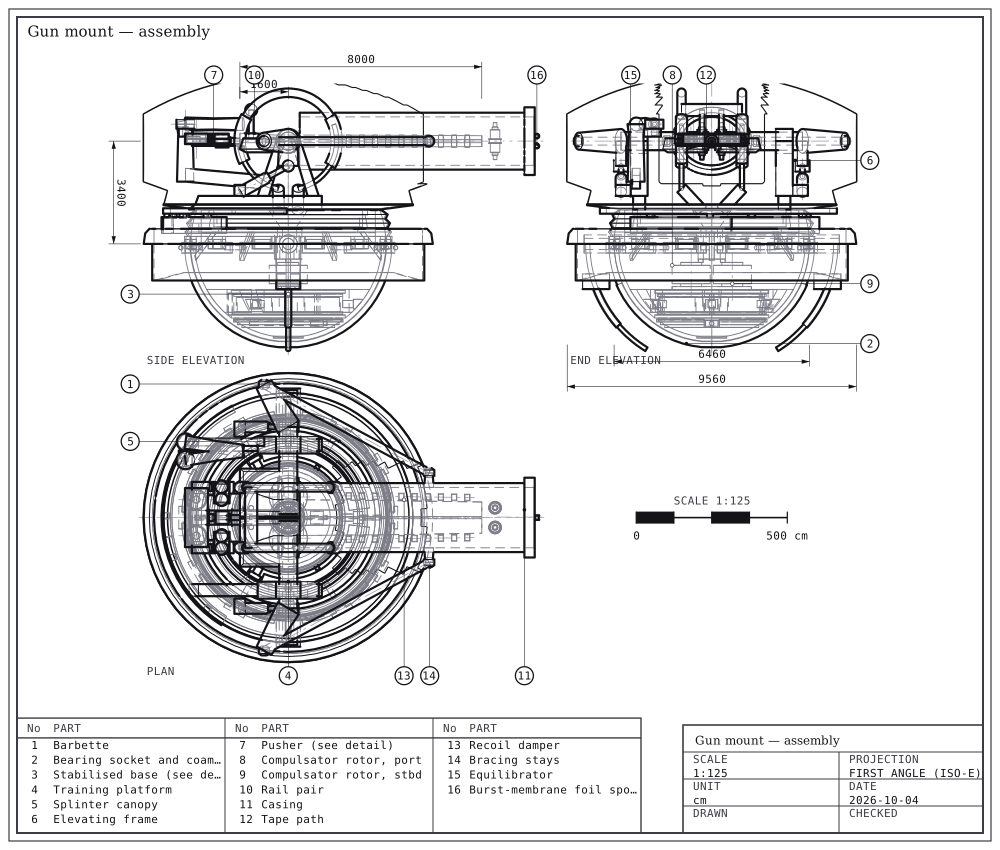
| Main gun | rail gun, barrel 8.0 m; elevation -3 to +35 deg, training +/-170 deg |
| Stabilisation | by gravity, +/-15 deg on two axes: a cap of 532 t on a sphere 6.46 m across |
| Pendulum depth | centre of mass 17.3 cm under the pivot with the gun level, 5.0 cm at full elevation |
| Counterweight | 21.9 t of tungsten in two halves on an arc rail, opening 21.7 and 29.2 deg at full elevation |
| Ballast | 52 t in the keel pocket and 62 t in the belt round the reaction mass |
| Brake | 12 shoes on the equator, drawn by a contracting loop |
| Gunhouse | glass-fibre shell of 4.6 t, radius 4.8 m, over a barbette 9.56 m across |
| Missile cells | 16 |
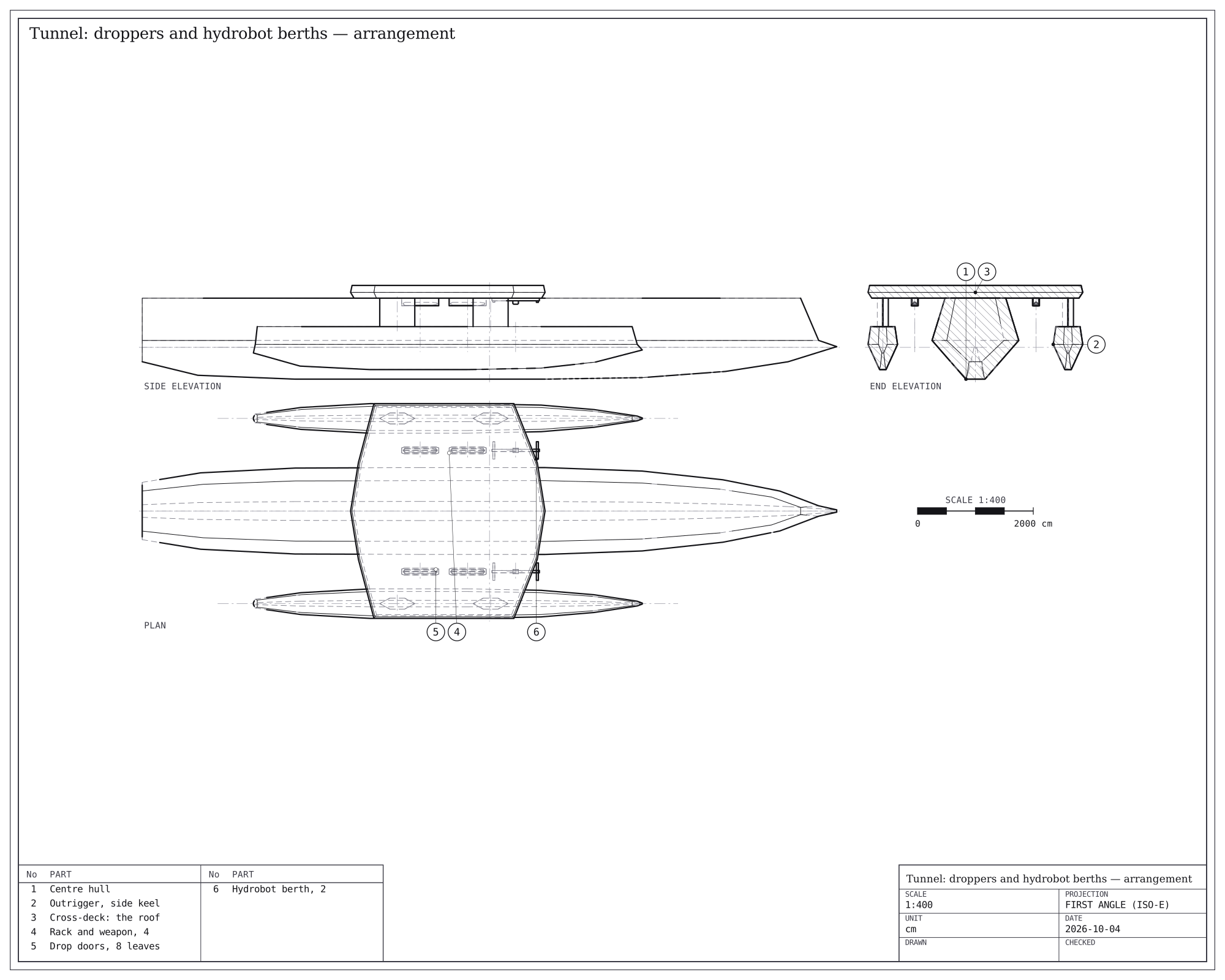
| Hydrobot berths | 2 |
| Torpedoes | 4 |
How the gun works
The main gun is a rail gun: two parallel rails 8 m long with a channel 70 mm across between them, and a current of about 3 MA driven up one rail, across an armature and back down the other. The force on the armature is half the rails' inductance gradient times the current squared, some 2.3 MN, and in 1.4 ms it carries a 100 g projectile in its sabot, about 280 g in all, to roughly 11 km/s.
What such a current does to a rail is the reason for most of what stands round the barrel. The face the armature rides on is not the rail itself: it is a copper tape 102 mm wide laid along it and renewed from a cassette at the breech. The arc sits on the tape; the tape is drawn on between shots and rolled to its profile afresh on the way in, so the surface the next round meets is always new. The tape survives because it carries only about a fifth of the current, the rest diffusing into the rail under it.
The round does not start from rest under full current. A pneumatic pusher on the bore's own axis, behind the breech, throws it onto the rails at about 300 m/s: dry nitrogen at 4.3 MPa, 53 kN over a stroke of 508 mm. That speed adds a thousandth to the muzzle energy and is not there for ballistics. It is there so that the arc never stands in one spot at the breech.
The barrel is pumped down for the shot and closed at the muzzle by a foil membrane the projectile breaks. Eight metres of air in the channel weigh half as much as the projectile, and the scatter of muzzle velocity that air would cause is the largest term in the accuracy budget: velocity matters more than aim. Between shots the same volume is purged with dry gas from the breech.
The pulse comes from two compulsators, pulsed alternators whose rotors stand side by side in the stabilised cap under the gun and turn in opposite senses, so that discharging them gives the mount no reaction torque. They are spun up from the ship through the mount's joints. The pulse itself never leaves the cap and the gun above it.
Why it is built this way
The mount took its shape by elimination: each line below is the survivor of several arrangements that were drawn, measured and dropped. The design journal keeps the ones that were dropped, with the reasons.
| A stabilised hemisphere | The whole mount stands in a cap that is half a sphere, 6.46 m across, riding a film of oil in a spherical seat. The cap takes the ship's roll and pitch, up to 15 deg on two axes, out of the problem before training and elevation begin, so aim is two angles in a level frame. A sphere turned about its own centre is the same sphere, and that is what lets a fixed seat, a fixed brake and a fixed barbette stand round a body that tilts. |
|---|---|
| Centre at deck level | The sphere's centre lies in the plane of the deck opening, so tilting turns the cap in its bore instead of walking it sideways. A metre higher or lower and 15 deg moves the rim 26 cm, which is a moat round the turret on a ship that is supposed to show nothing. |
| Hydrostatic seat | Friction is 16.9 kN.m under a load of 5.22 MN. A plain bearing would give fifty times that, and no stabiliser could work against it. |
| Gravity, a wheel and a brake | The cap is a pendulum: its centre of mass hangs 17 cm under the pivot with the gun level and 5 cm at full elevation, held there by tungsten in the bowl. A heavy slow ring in the bowl, ballast that is also made to turn, answers fast disturbances as a reaction wheel of 100 kN.m.s. 12 shoes on the equator clamp the cap to the ship for every shot, so recoil goes into the hull, and the same clamping unloads the wheel. |
| A counterweight that opens | The gun's centre of mass stands ahead of the trunnions, so raising the barrel would carry the cap's centre aft and tip the pendulum. The counterweight is two halves on an arc rail that run apart as the gun elevates, 22 and 29 deg at full elevation, and keep the centre on the axis. Its mass and height do not change. |
| Coaxial current path | Megaamperes cross the training joint on its axis as a coaxial pair: the inner conductor live, the outer the return at structure potential. Everything a hand can reach is at return potential, and the repulsion between the two conductors is contained by the pair itself. The gap between them is an insulation dimension, not a strength one. |
| Telescopes at the joints | Every joint the current has to follow is crossed by a rod sliding in a sleeve bent to an arc about that joint's own axis: about the trunnions for elevation, and as a Cardan pair, roll outside and pitch inside, for the cap's tilt. Nothing flexes. Because the compulsators stand in the cap, the tilt pair carries only their spin-up power, and the pulse crosses two joints instead of four. |
| A barrel inside a casing | During the pulse the rails spread with some 26 MN per metre and the recoil is 756 kN along the bore. The large loads are either closed inside the rail block or strictly axial; what spoils accuracy is small and sideways. So the block hangs inside an outer casing on 20 absorbers: the casing takes the sea, the heat and the mount's motion, and the block keeps a straight line. Two stays brace the casing back to horns on the trunnion shaft. |
| Recoil without a recoil system | The impulse is 3.2 kN.s against about a hundred tonnes of elevating mass: three centimetres a second. A millimetre of sprung travel under the trunnion bearings cuts the force they see twentyfold. |
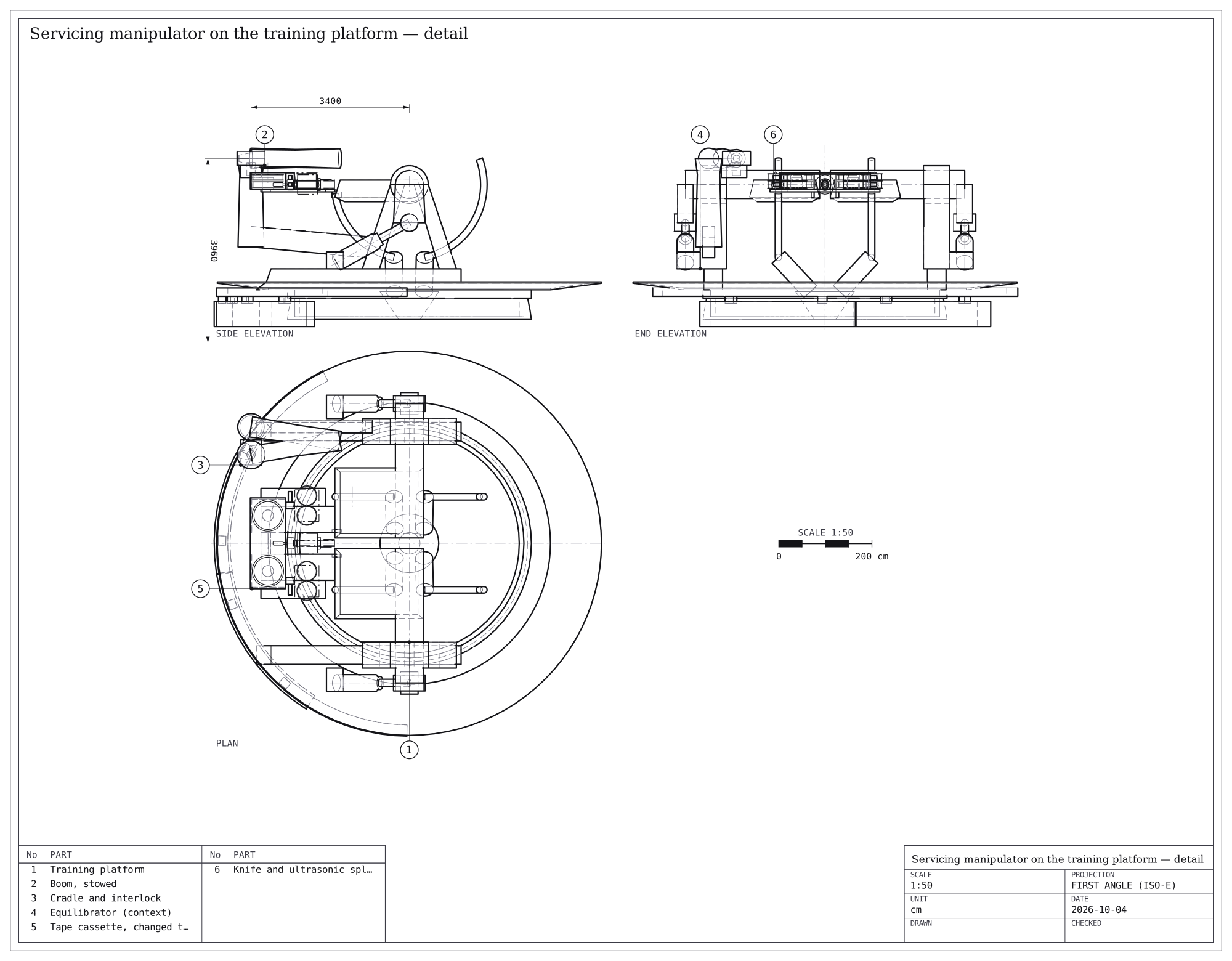
| Rolls, and one arm to change them | The rail tape and the muzzle foil are both rolls, so servicing is one kind of job. A manipulator on the training platform exchanges cassettes through a hatch in the gunhouse; cutting and ultrasonic splicing of the tape are done by fixed stations at the breech, because the four splice points never move. |
| A light gunhouse | The shell over the mount trains and tilts with it, so its mass is in the stabiliser's budget. In steel it put the cap's centre of mass above the pivot; it is a glass-fibre shell of 4.6 t. |
The firing cycle
- The round, a bolt in its sabot, is seated in the cradle cut in the pusher's piston, which sets its clocking in the channel.
- The barrel and the breech flask, between 130 and 230 litres, are pumped down. A fresh frame of foil closes the muzzle.
- The equatorial brake clamps the cap to its seat. From here to the end of the shot the mount is part of the ship.
- The pusher fires. A coil at the breech reads the piston's speed, and only a piston moving fast enough closes the firing circuit: the threshold is a velocity gate, so a slow start cannot be followed by a pulse.
- The contactors close and the compulsators discharge through the coaxial joint, the elevation telescopes, the bus over the barrel and the bridge onto the rails: about 3 MA for 1.4 ms.
- At the muzzle the sabot's petals part and the foil bursts. The recoil, 3.2 kN.s, goes through the breech and the trunnions into the clamped cap and the hull.
- Within a few milliseconds of the round leaving, the purge valve opens. Dry gas from the breech sweeps the channel and keeps the sea air out of it, and its pressure on the piston's face re-cocks the pusher: one throttle washer in place of a spring, a brake and a cocking drive.
- The tape is drawn on, the foil advances one frame, the brake lets go and the cap hangs free again while the compulsators are brought back up to speed.
The tempo is set by energy, not by mechanism: about two rounds a minute. The reaction wheel would saturate against the seat's friction in 6 s if nothing unloaded it, which the brake does at every shot.
Estimated performance
Figures given as 'about' are estimates from the design journal and are not held by the model. The rest are read from the model.
| Projectile | about 100 g: a bolt 254 mm long and 12 mm across in a discarding sabot, about 280 g on the rails |
|---|---|
| Muzzle velocity | about 11 km/s |
| Muzzle energy | about 18 MJ for the whole round, 6 MJ of it in the projectile |
| Current and pulse | about 3 MA for 1.4 ms |
| Energy drawn per round | about 80 MJ electrical, at a quarter efficiency |
| Barrel | 8.0 m of rails; channel 70 mm across, contact track 101.6 mm |
| Injection | about 300 m/s from the pusher: 4.3 MPa of nitrogen, 53 kN, stroke 508 mm |
| Arcs | elevation -3 to +35 deg, training +/-170 deg, stabilisation +/-15 deg on two axes |
| Reference range | 100 km, where 0.1 per cent of velocity scatter is about 200 m |
| Rate of fire | about two rounds a minute |
| Recoil | 3.2 kN.s; about 756 kN along the bore during the pulse |
| Stores | a tape cassette of about 240 kg for 30 rounds; muzzle foil for several hundred |
| Heat | about 2.75 MJ into the mount per round: some 3 K over 30 rounds, cooled between engagements rather than during them |
| Stabilised mass | 532 t on the seat |
Designed but not in the model
The model is the mount as it would be seen through its own structure: everything in it is connected to something. These parts of the design were worked out in the journal and are not drawn.
- The ammunition magazine and its exchange. The round is taken as arriving in the pusher's cradle. Where rounds are stowed, how a magazine reaches the breech and how an empty one is changed are not modelled; the tape cassette, its hatch and the arm that carries it are.
- The thunder generator. The design's prime store of energy is propellant, not a flywheel hall or a capacitor bank: charges of battleship size fired inside the hull against captive pistons that compress magnetic flux, about 320 MJ of chemical energy for a round. It is what sets two rounds a minute, and its name is literal: the most modern gun on the ship fires only after the hull has thundered the old way. The model stops at the compulsators in the cap.
- The pulse interrupter. A current built up in an inductance has to be thrown into the rails by breaking a circuit that carries megaamperes. The journal's answer is a sacrificial fuse, a fourth consumable after tape, foil and powder. It is not modelled.
- The drive of the counterweight. The position of its halves is a function of elevation alone, a cam or a winch off the elevating drive; the mechanism is not drawn.
Assembly sheets
 shipTrimaran gun vessel — general arrangement
 tunnelTunnel: droppers and hydrobot berths — arrangement
 robotServicing manipulator on the training platform — detail
 mountGun mount — assembly
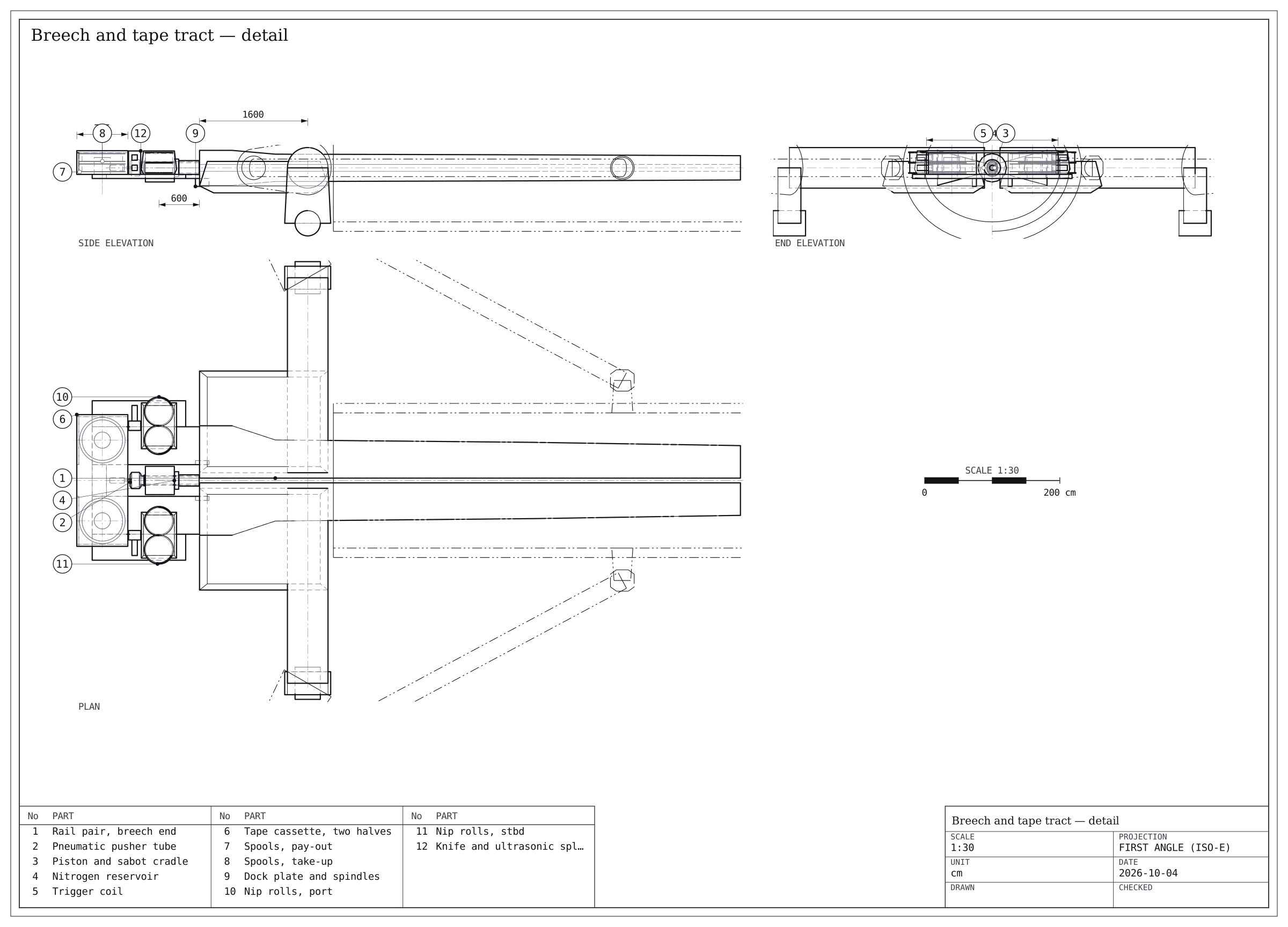 breechBreech and tape tract — detail
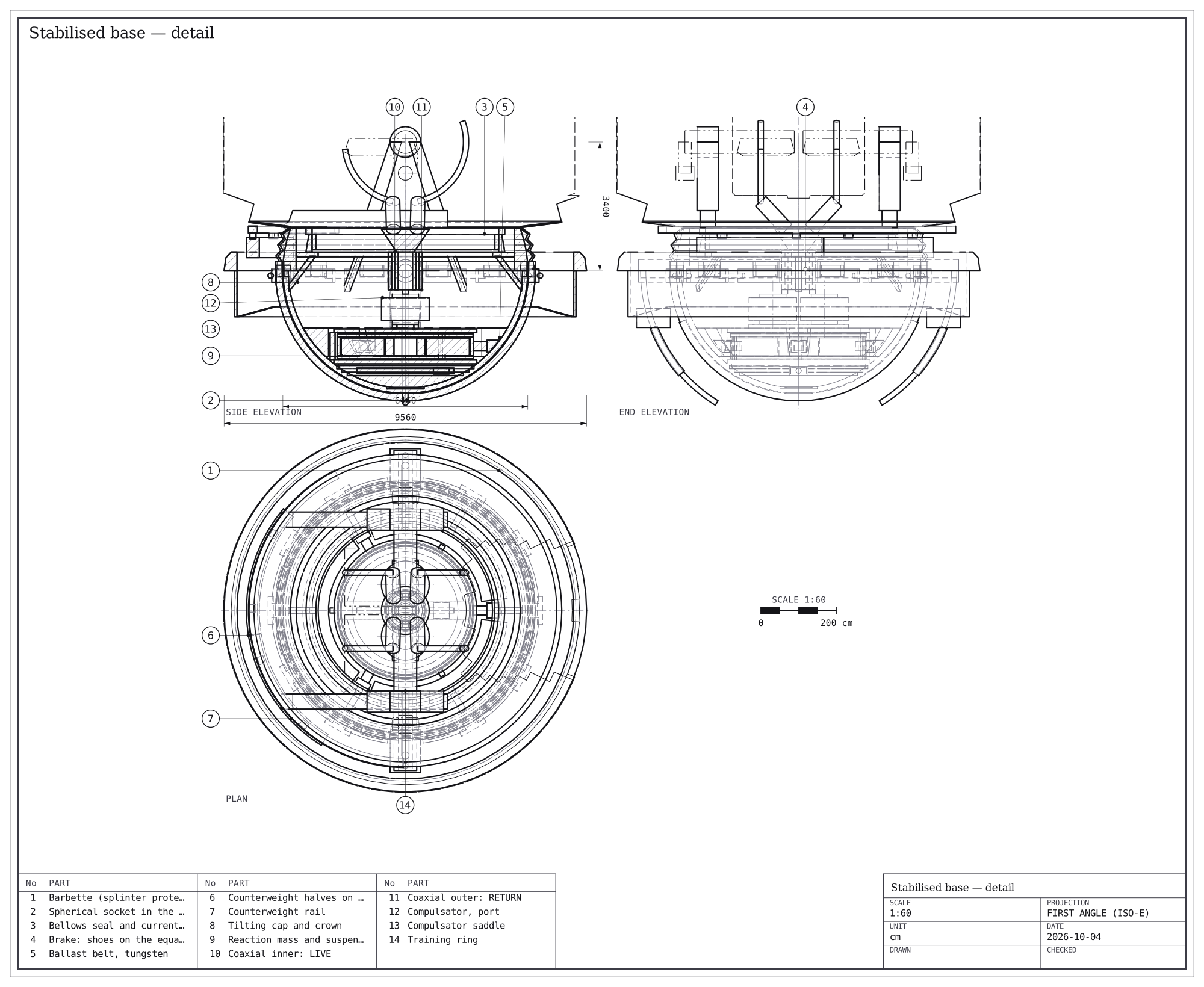 baseStabilised base — detail
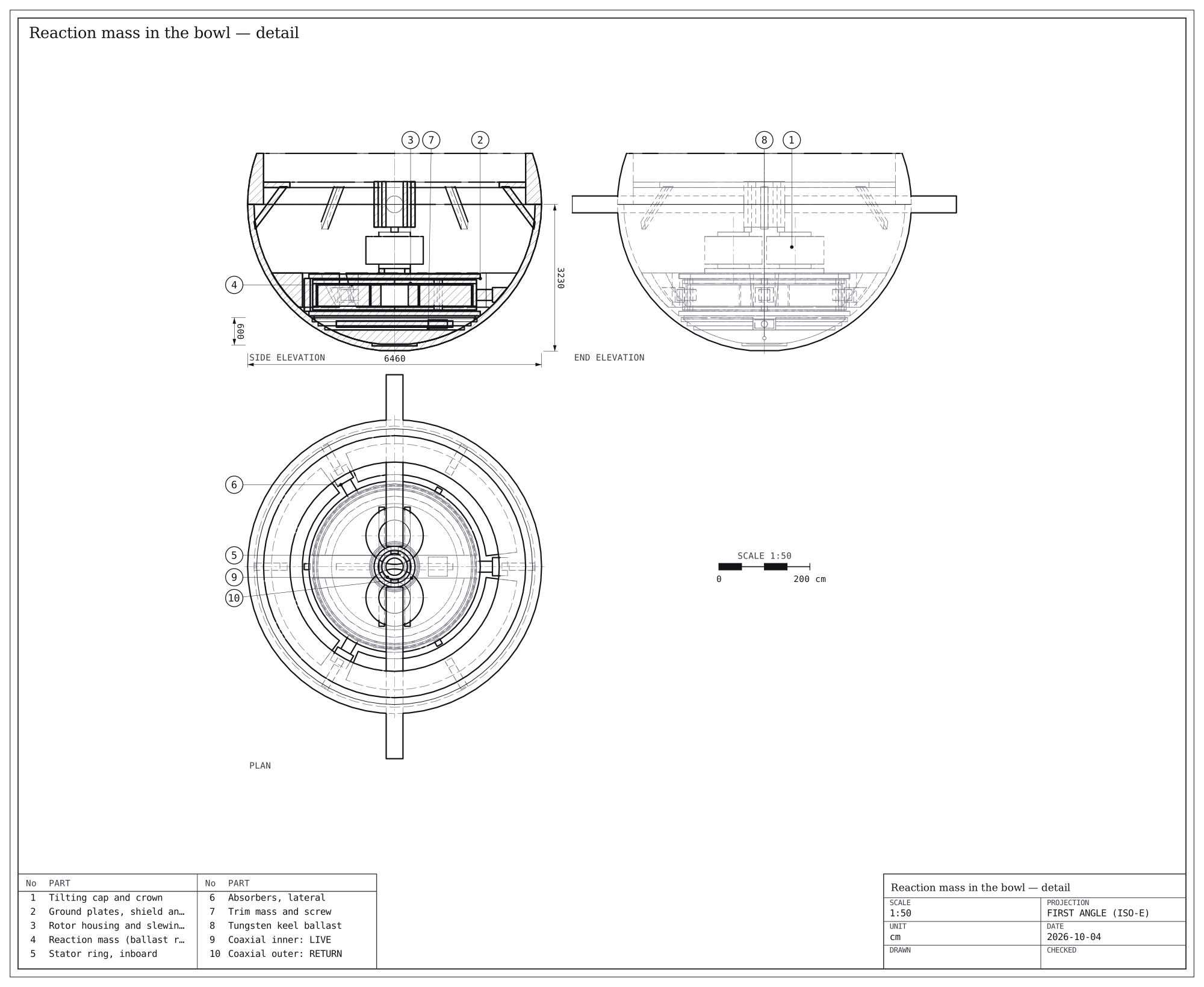 bowlReaction mass in the bowl — detail
Arrangement and structure
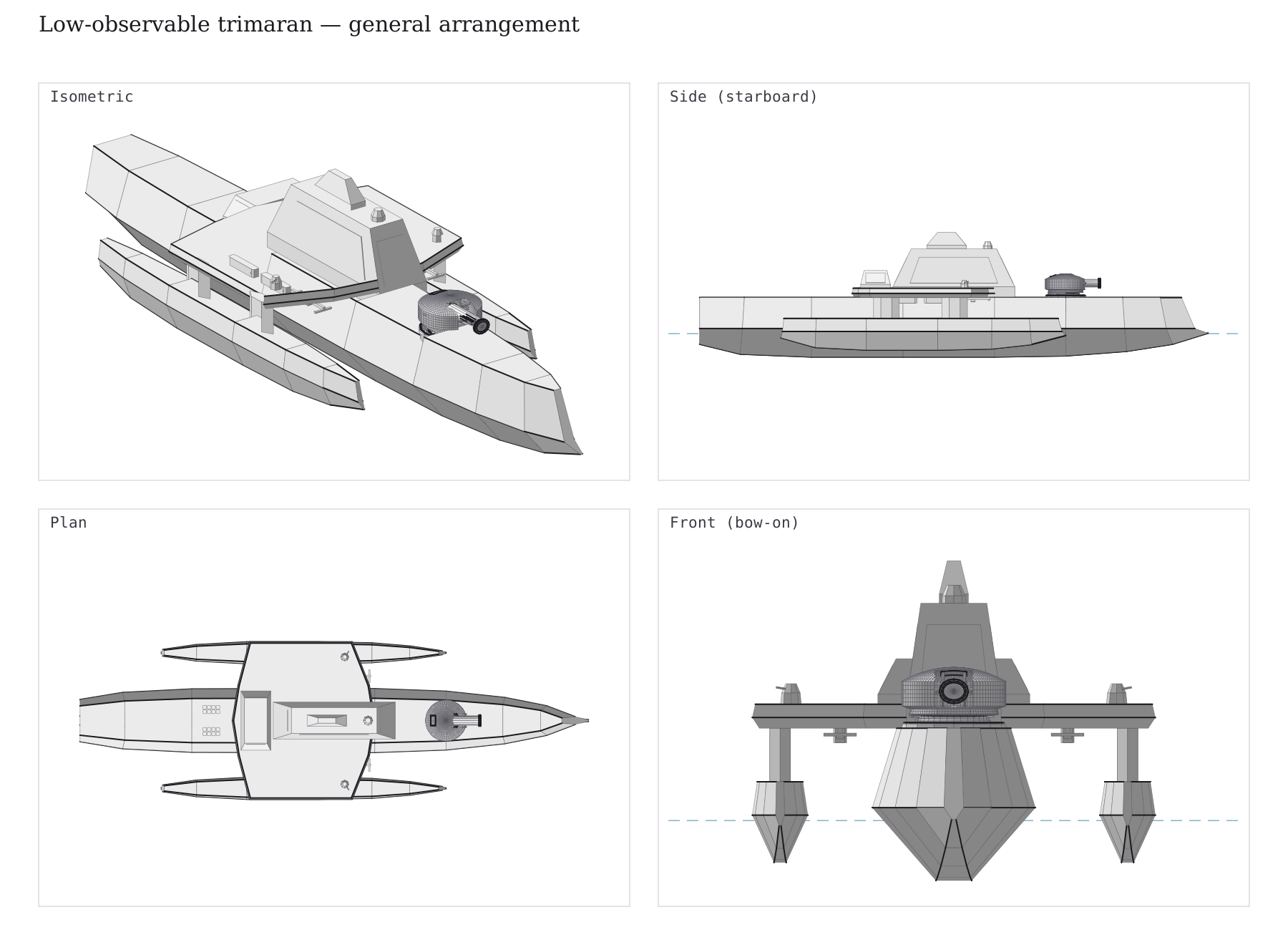 arrangementLow-observable trimaran — general arrangement
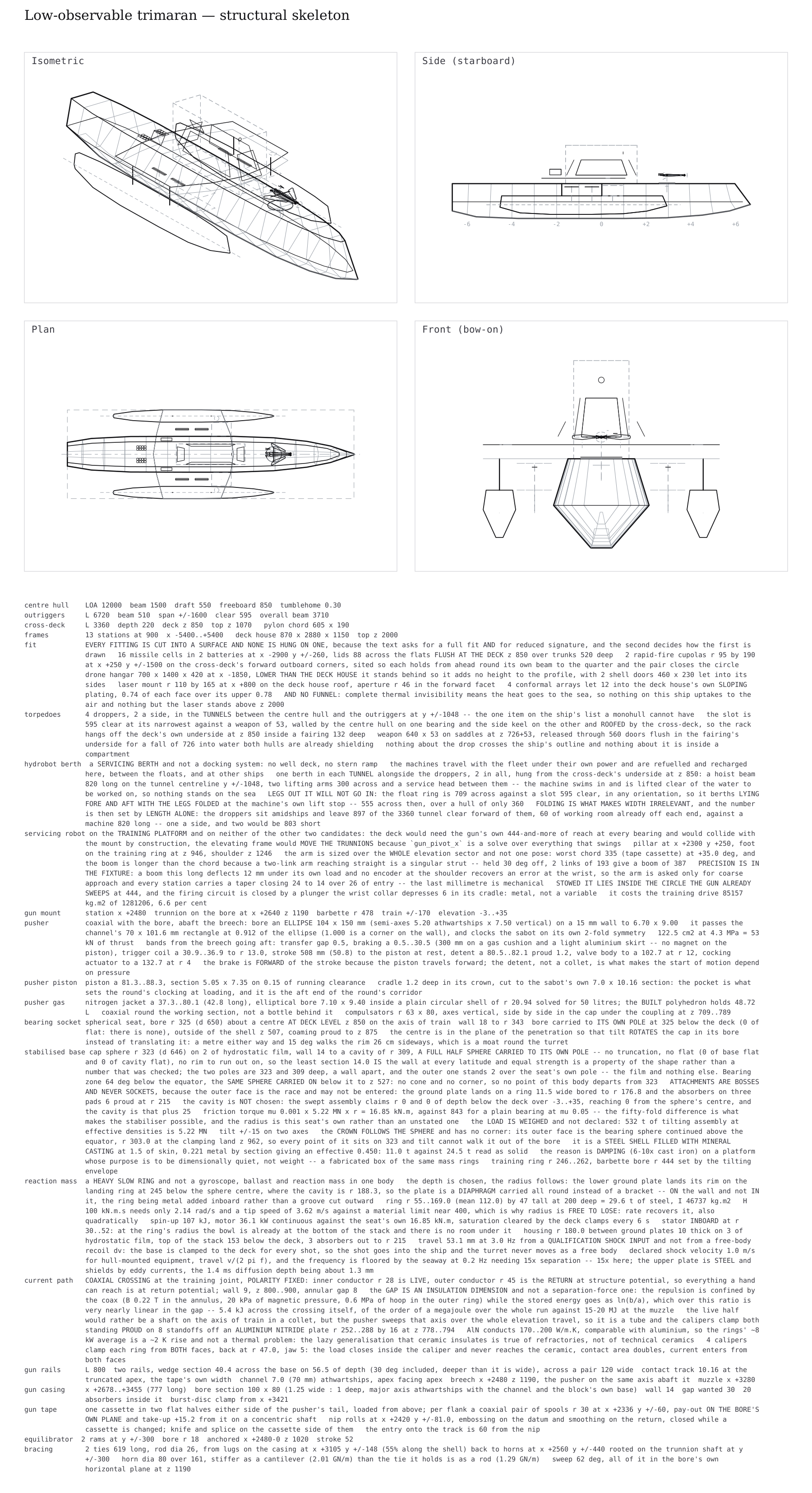 skeletonLow-observable trimaran — structural skeleton
Interactive and sources
- Interactive stand: the stabilised base of the main gunEvery node of the mount with its dimensions and the reason for each; sliders for roll, pitch, elevation and training. In Russian.
- Model sourcesmodel.json, adapters.py and checks.py: the parametric model every sheet on this page is built from.
- Design journalWhat was decided, why, and what is still open. In Russian.
Meshes
Meshes are cheap to rebuild and are not kept under version control: build.py --obj and --stl write them to mesh/ beside this page.
Every sheet, figure and mesh on this page is generated from one parametric model, and nothing is written until its geometry checks pass. Lengths in the sheets are in centimetres unless a dimension line says otherwise.